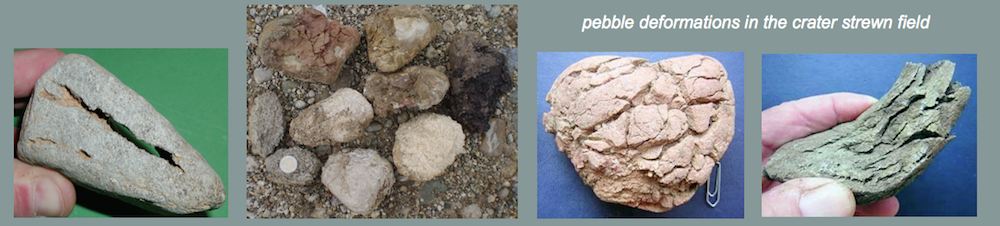
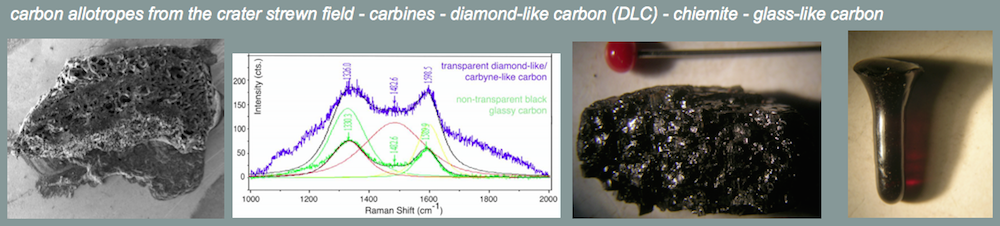
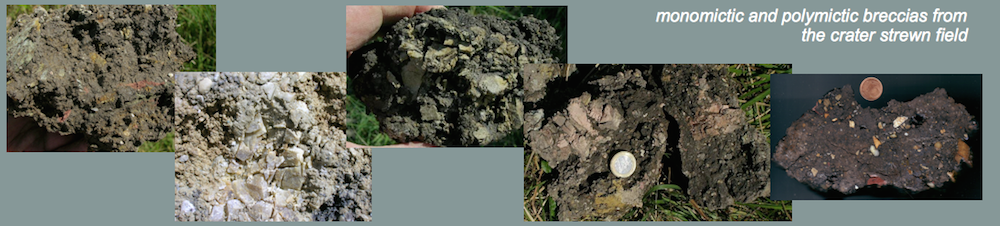
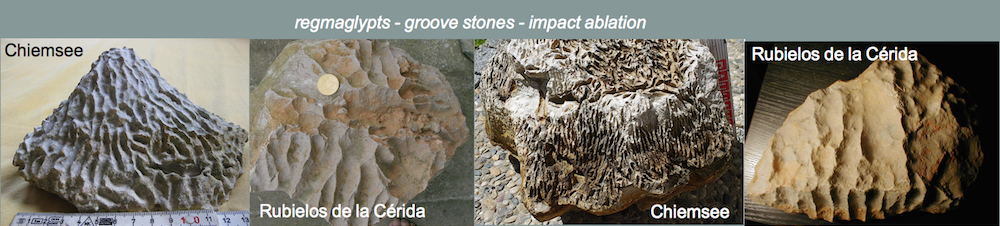
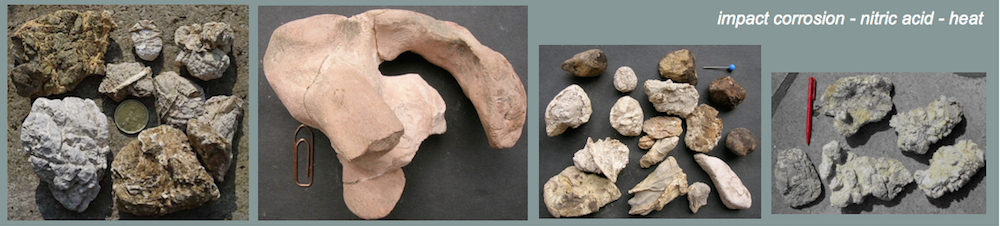
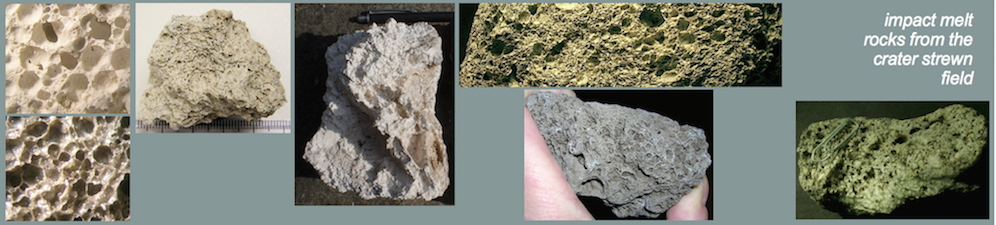
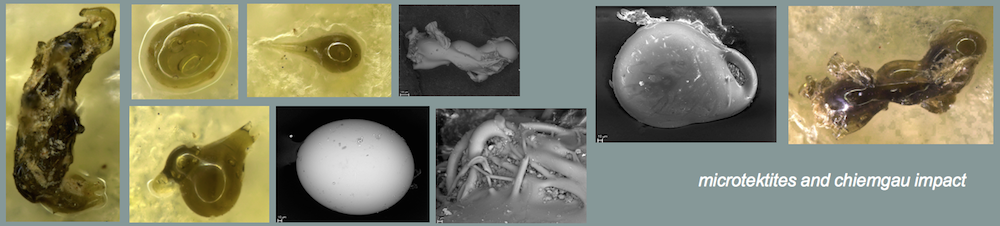
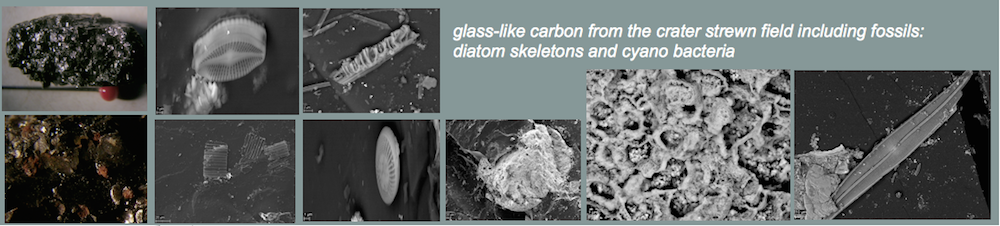
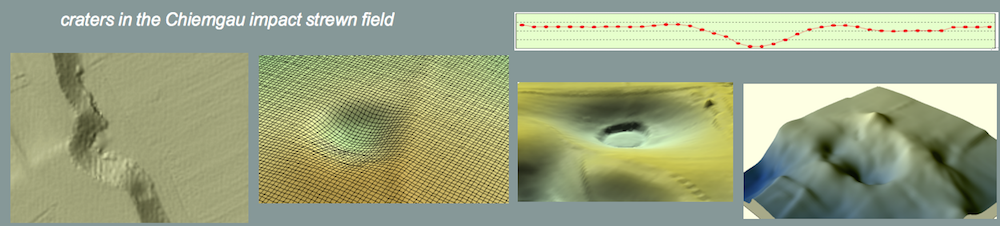
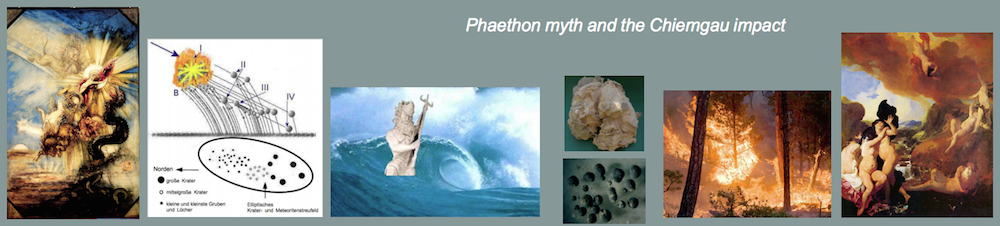
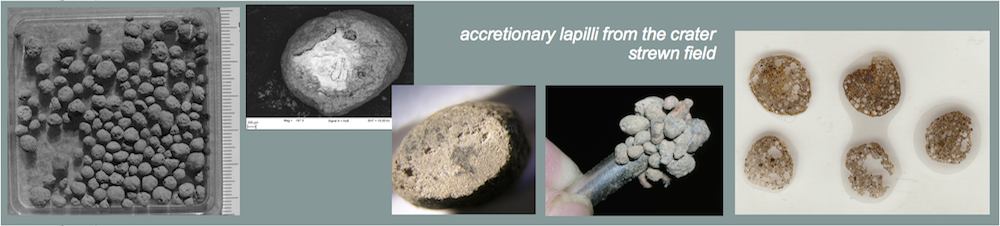
This excellent text page was generated and translated from the German by Hans Matheisl using his AI assistant.
Chiemgau impact hypothesis – the English Wikipedia Opinion Machine
Although brief, the entry on the Chiemgau impact on Wikipedia reveals the site to be a platform for opinion with a biased and partisan administrator. We will also keep this brief and refer readers to the website, which contains a list of approximately 45 contributions on the current state of scientific research into what is likely the most significant impact event of the Holocene to date. These papers (mostly to be downloaded) appeared in internationally renowned journals and were published as peer-reviewed papers at the Lunar & Planetary Science Conferences, the Meteoritical Society Meetings, and the Fall Meetings of the American Geophysical Union.

Chiemgau impact: Wikipedia ad absurdum
Chiemgau impact: Wikipedia has mutated to a manipulation machine, initiated by well-known scribblers and opponents of the Chiemgau Impact who remain unrepentant to this day.
Translated from the German Wikipedia article:
Chiemgau Impact
The term “Chiemgau Impact” refers to a disproved hypothesis concerning the impact of a comet or asteroid that is said to have exploded after entering Earth’s atmosphere, with its debris allegedly falling in the Chiemgau region. The impact is said to have occurred between 2200 and 300 BCE.[1] [2]
The hypothesis regarding the existence of a Chiemgau impact, first proposed by amateur archaeologists in 2000, has since been refuted by several independent studies in the fields of geology (sediment analysis), botany (pollen analysis), and dating (radiocarbon method).[3][4] [5]
Studies that contradict the Chiemgau impact hypothesis
The hypothesis of an extraterrestrial impact in the Chiemgau region, first proposed at the beginning of the century, has not yet been confirmed. Several independent studies consider the hypothesis to be refuted.
Gerhard Doppler and Erwin Geiss, geologists at the Bavarian State Office for the Environment (LfU), concluded in 2005, following a field survey of Lake Tüttensee and the surrounding area, that the interpretation of the lake as an impact crater is extremely unlikely. [6] …..
… and more old as dirt rubbish … enabled by the biased Wikipedia operator.
To return to the truth, click here.
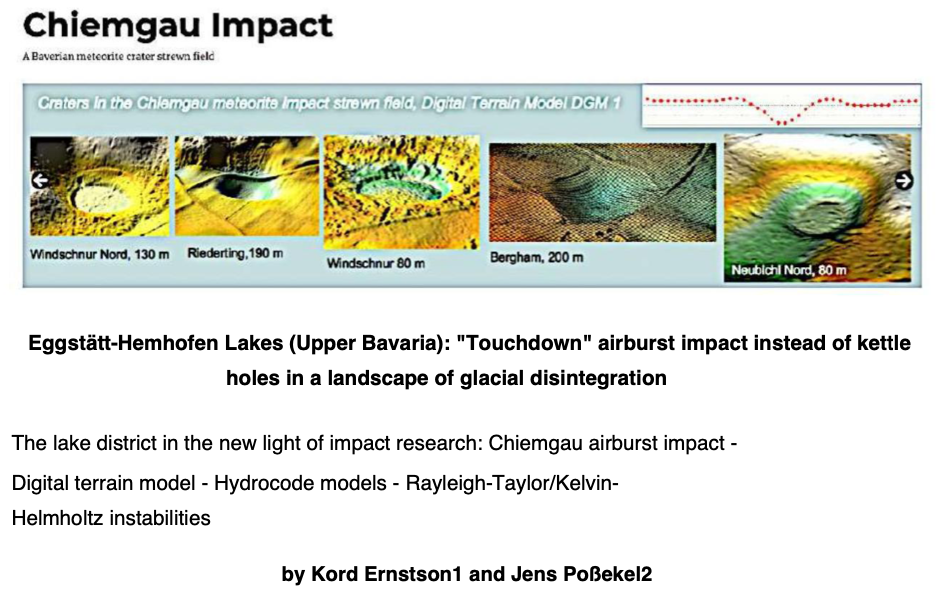
Eggstätt-Hemhof Lake District – impact area instead of ice age
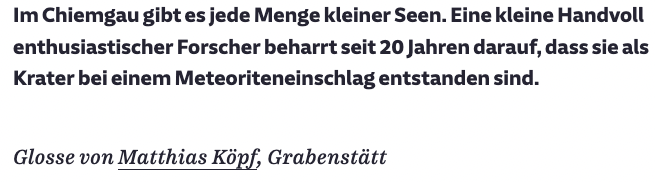
Matthias Köpf from the SZ: a “commentary” on the Chiemgau impact
By chance, I (K.E.) came across this article from October 2025 (!) in the Süddeutsche Zeitung (SZ) newspaper today:
https://www.sueddeutsche.de/bayern/chiemgau-tuettensee-meteoritenkrater-li.3322897


My comment: I haven’t read a more stupid article about our impact in a long time – and that in the SZ. Not a glorious moment for the SZ! It reads as if R. Darga guided the journalist’s pen. According to the article, Matthias Köpf is from Grabenstätt. Perhaps he should visit the town hall there and the Impact Museum in the Schloßökonomie.
But this fits in perfectly with the latest very informative article written by H.-P. Matheisl from KI, which can be clicked on here:
The Chiemgau impact and the Digital Terrain Model DGM 1
Article Part 3: the larger-sized craters

Continuing our description with a summary of the impact inventory of the Chiemgau strewn field (Part 2, Part 1) we present here the third part, which is again published on the science portals Researchgate and Academia as as preprint. The article can be downloaded here as a PDF file (click on the title):
The Chiemgau Impact (Germany) meteorite crater strewn field and the role of Digital Terrain Models. – Model craters, Part 3: the large craters – Lake Brunnensee/Griessee crater, Lake Obing crater, the Tittmoning (Asten, Leitgering) craters, Lake Chiemsee multiple crater, Eglsee crater, Lake Eschenau and Lake Laubensee craters, Lake Bärnsee crater, Lake Tüttensee crater ensemble. – K. Ernstson and J. Poßekel
The Chiemgau impact and the Digital Terrain Model DGM 1
Article Part 2: the medium-sized c
Article Part 2: the medium-sized craters

Continuing our description with a summary of the impact inventory of the Chiemgau strewn field (Part 1), we present here the second part, which is again published on the science portal Researchgate as a preprint. The article can be downloaded here as a PDF file (click on the title):
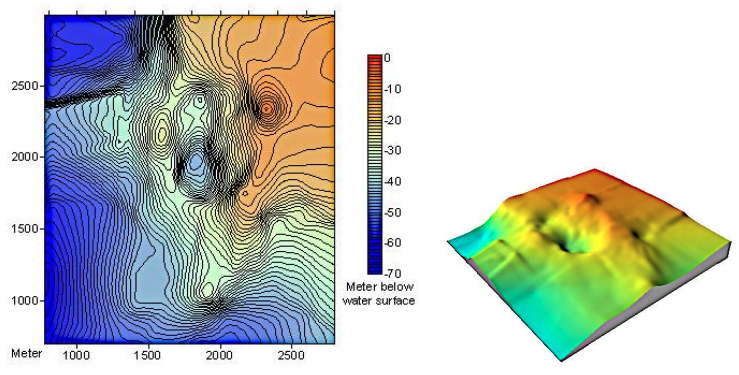
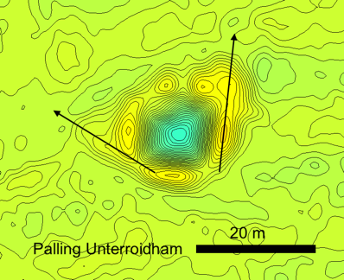
The start image above shows a topographic map and terrain surface of the digital terrain model DGM 1 for the natural monument at the Seeon horse farm, which has always been listed in maps and descriptions as a typical dead ice hole from the last ice age and is listed by the Bavarian State Office for the Environment (LfU) as a geotope particularly worth seeing.
The DGM 1 symbolizes a necessary rethinking of the LfU’s Bavarian ice age research, which continues to adhere to a dead ice hypothesis that has never been scientifically or geologically substantiated, with countless so-called dead ice holes and their designation as geotopes, which was recently documented in an article and can be seen as an example of scientific falsification by the LfU in the case of the Tüttensee meteorite crater.
2 contributions to the AGU Conference 2025
The following two iPosters have been accepted for presentation at the renowned American Geophysical Union conference in New Orleans in December. The abstract announcements can now be downloaded:
AGU website:
Each year, AGU’s annual meeting, the largest gathering of Earth and space scientists, convenes 25,000+ attendees from 100+ countries to share research and connect with friends and colleagues. Scientists, educators, policymakers, journalists and communicators attend AGU25 to better understand our planet and environment, opening pathways to discovery, opening greater awareness to address climate change, opening greater collaborations to lead to solutions and opening the fields and professions of science to a whole new age of justice equity, diversity, inclusion and belonging.
Ice Age, dead ice, meteorite impact, and the digital terrain model

The complete article can be downloaded here as a PDF file:
***********************************
The Schlitzer Kauten (Hesse) and the high-resolution Digital Terrain Model DGM 1: an airburst impact event with a crater strewn field
Kord Ernstson, Jens Poßekel and Rudolf Auth
Please note that this article is a computer translation of the original German text and may contain incorrect wording.
New Poster: meteorite impact and the Digital Terrain Model
Lunar & Planetary Science Conference LPSC 2025
MetSoc Meeting 2025
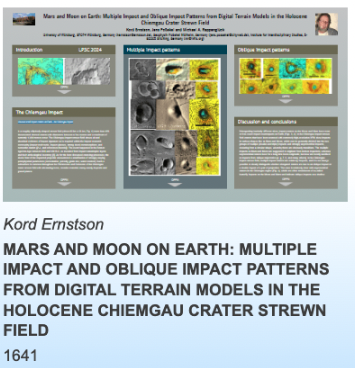
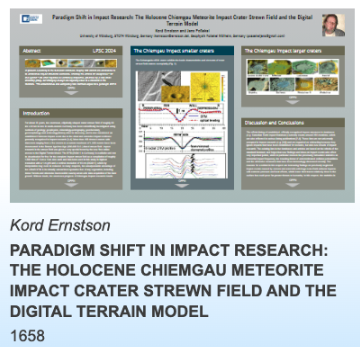
Lunar & Planetary Science Conference LPSC 2024
https://lpsc2024.ipostersessions.com/?s=40-83-1A-8D-B8-91-6E-54-A4-F3-B3-36-13-85-48-1F


https://lpsc2024.ipostersessions.com/?s=D7-F9-72-1A-EB-74-15-15-BC-2B-1B-DC-54-85-E6-C9
AGU Meeting 2024

New article: The Chiemgau impact and the Digital Terrain Models of impact structures
A new article has been published as a Researchgate preprint:

The full article may be clicked here:https://www.chiemgau-impact.com/wp-content/uploads/2024/09/Emmerting-Artikel-18.9.-webdocx-3.pdf
New review article: Chiemgau meteorite impact event
People experienced the prehistoric Chiemgau meteorite impact – geoarchaelogical evidence from southeastern Germany: a review
Barbara Rappenglück, Michael Hiltl, Jens Poßekel, Michael Rappenglück, Kord Ernstson
Mediterranean Archaeology and Archaeometry, 23, No. 1, 209-234, 2023.
http://maajournal.com/Issues/2023/Vol23-1/8_Rappengluck_et_al_23(1).pdf (full article free open access)
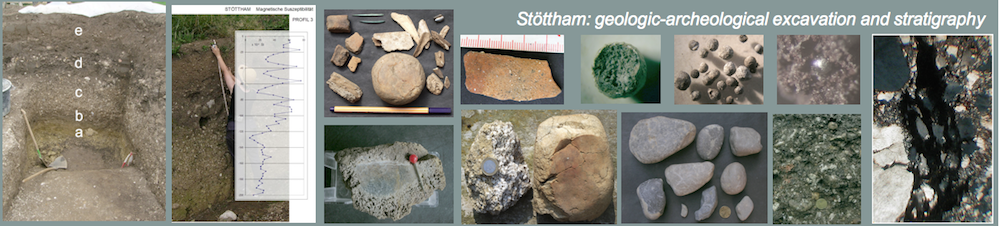
Abstract. – Archaeological sites undoubtedly destroyed by a meteorite impact had not been identified so far. For such a proof, both a meteorite impact and its definite effects on an archaeological site would have to be evidenced. This review article reports on geoarchaeological investigations, involving mineralogy, petrography, and geophysics, which established evidence that two prehistoric human settlements have been affected by the Late Bronze Age/Early Iron Age (ca. 900-600 BC) Chiemgau meteorite impact in southeastern Germany. One site, the Mühlbach area, was affected by the ejecta from the 600 m Ø-Tüttensee crater, one of the largest craters in a crater strewn field measuring about 60 x 30 km. At the other site, Stöttham close to Lake Chiemsee, the catastrophic layer of the impact was found embedded in the archaeological stratigraphy of a settlement, which had been repeatedly occupied from the Neolithic to the Roman era. At both sites, artifacts have become components of impact rocks, establishing a hitherto unknown form of an impact rock, an artifact-in-impactite. The immediate coexistence of rocks, which exhibit impact-diagnostic shock metamorphism, with relicts of metallic artifacts, as encountered in finds from Stöttham, are unprecedented evidence of human experience of a meteorite impact.
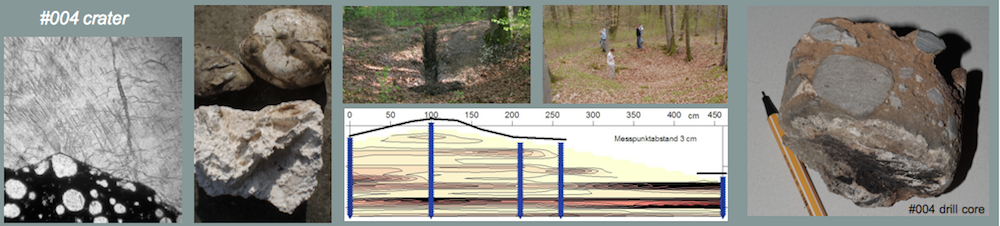
Chiemgau impact LPSC 2023 Emmerting #004 crater

Comment on
by Kord Ernstson, University of Würzburg
At this year’s LPSC 2023, there is a paper by Vaclav Procházka on mineralogical investigations of two craters of the Chiemgau impact in southeastern Germany:
https://www.hou.usra.edu/meetings/lpsc2023/pdf/2102.pdf
It reports about impact melting of crater cobbles and about a meteorite fragment in crater Emmerting 4 (in the previous impact literature crater #004). Although these are interesting new findings presented in the poster, Procházka’s contribution does not show great scientific honesty, to say the least.
Crater #004 near Emmerting is listed by Procházka as one of several other craters and depressions as having been studied for about two decades, but a clear classification as an impact crater is denied. Only a reference to an affirmative work of 25 years ago is quoted, but extensively referred to inapplicable explanations of anthropogenic origin.
We remind Procházka that he already many years ago sought the contact to us, was with us in the area of the 60 km x 30 km large Chiemgau impact crater strewn field and discussed respective researches. He himself has published on studies at Kaltenbach crater with its impact effects.
A published seminar presentation on the Chiemgau impact was held on March 8, 2016, at the Institute of Geochemistry, Mineralogy and Mineral Resources, Charles University, Prague, on the Chiemgau impact, presented together with colleagues.
The presentation, translated from Czech may be downloaded here.
This detailed published work by Procházka on the Chiemgau impact crater strewn field (37 pages!), then known for 10 years, and its impact evidence is now simply hushed up at LPSC 2023. Not even the word Chiemgau appears in the text of his contribution.
I add:
At the LPSC alone, where now Procházka presents the #004 crater, there are seven contributions to the Chiemau impact in the years 2012 – 2020. Moreover, three contributions at the Planetary Crater Consortium meetings, also three contributions at the Meteoritical Society Meetings and two contributions at the AGU Fall Meeting can be added.
Eleven mostly peer-reviewed articles on the Chiemgau impact have been printed in scientific journals from 2006 – 2023.
Unfortunately Procházka joins the group of a few researchers from the so-called “impact community”, connected with the Earth Impact Database at the Canadian University of New Brunswick under the direction of John Spray, who also keep silent about the Chiemgau impact as the currently most important Holocene impact event with well over 100 craters, all proven impact criteria, and exciting published archeological references (also see here).
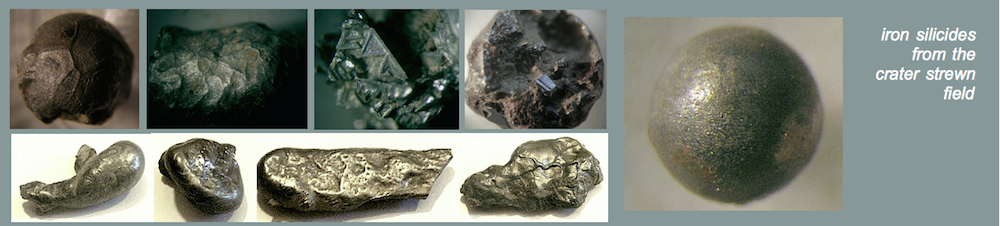
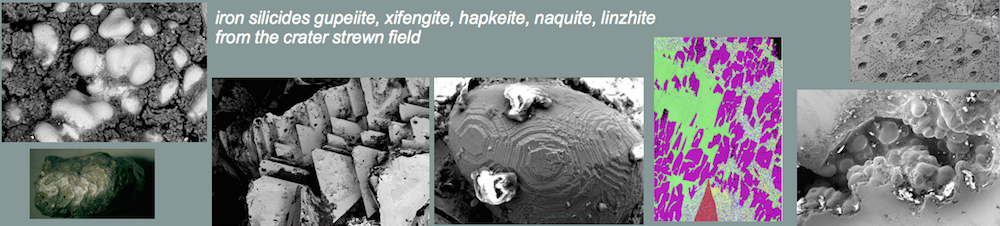
The Chiemgau-Impact iron silicides: hypothesis of a new class of meteorites strengthened
New article, open access download:
The Chiemgau-Impact iron silicides: hypothesis of a new class of meteorites strengthened

Mars on Earth
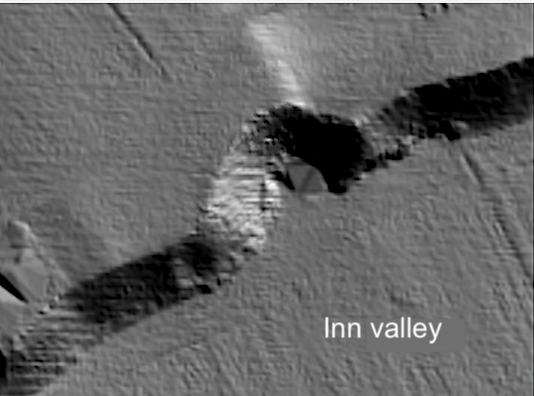
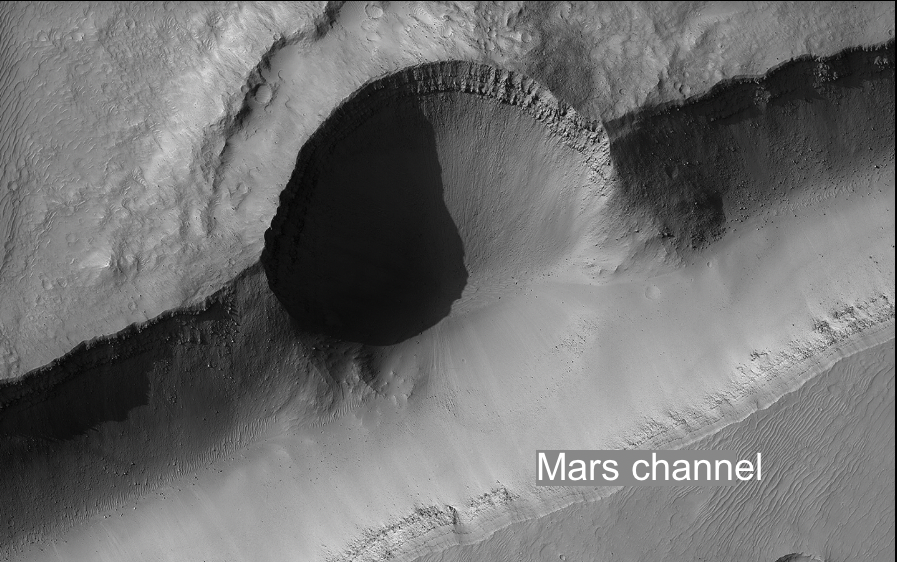
How much they resemble each other: Chiemgau impact and Mars impact.


Top: The Aiching/Dornitzen semi-crater punched into the Inn Valley slope today, after the other half has been “shaved off” by the Inn River.
Below: This image was taken by NASA’s Mars Reconnaissance Orbiter on March 12, 2022. It shows a crater punched into the Martian surface, exposing several previously formed layers. Half of the crater was then destroyed when the Mars channel was opened. – NASA/JPL-Caltech/University of Arizona.
Interestingly, the Chiemgau and Mars craters are about the same size (50 m), with objects about 1.5 m in size still resolved in the Mars crater image.
With respect to the Tüttensee crater, it is remarkable in this Mars crater that also a terrace-shaped ejecta rim has developed after a part of the crater-facing wall has flowed back into the hollow form.

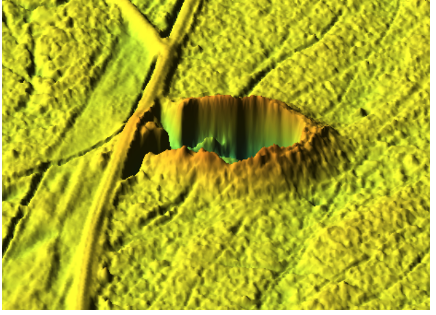
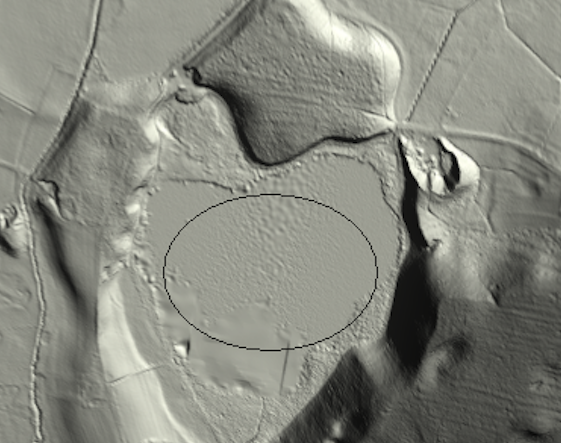
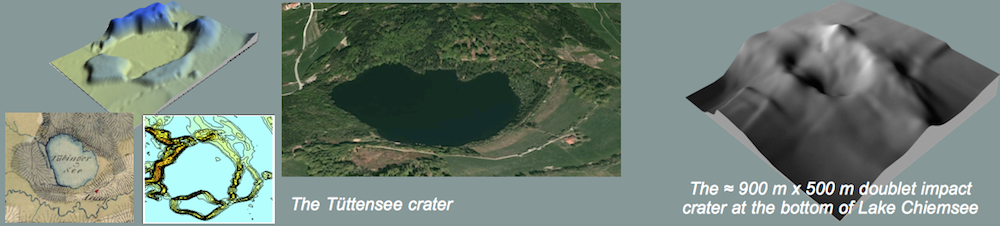
Digital terrain model DGM 1 of the Tüttensee crater with the true inner crater with a good 300 m diameter and the terraced ring wall measuring 600 m.
Secondary cratering on Earth: The Wyoming impact crater field: Much Ado About Nothing (Shakespeare)
A recent article by Kenkmann et al. in the GSA Bulletin titled
Secondary cratering on Earth: The Wyoming impact crater field
has led to a plethora of noticeable reactions especially on the internet and has led to an extensive critical commentary article that can be clicked HERE on the website for an introduction and HERE as a PDF. The commentary article, which comprehensively contrasts the Wyoming impact crater field with the Chiemgau impact crater field, accuses the authors of serious methodological errors and scientifically incorrect work. The conclusion is that this alleged Wyoming secondary crater field does not exist.

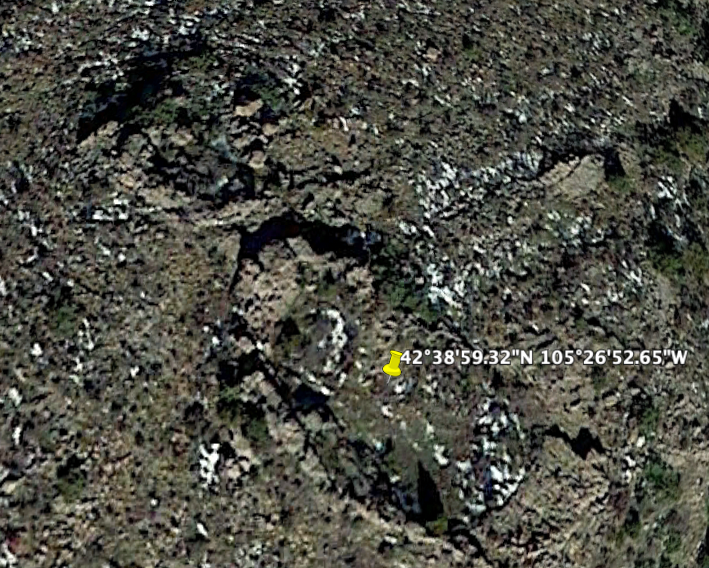
Three Examples of the Wyoming impact craters. Google Earth.

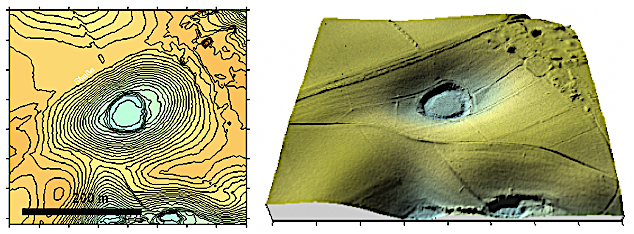
Chiemgau impact crater: Digital Terrain Model DGM 1 – topographic contour lines.