This excellent text page was generated and translated from the German by Hans Matheisl using his AI assistant.
Category: Allgemein
Chiemgau impact hypothesis – the English Wikipedia Opinion Machine
Although brief, the entry on the Chiemgau impact on Wikipedia reveals the site to be a platform for opinion with a biased and partisan administrator. We will also keep this brief and refer readers to the website, which contains a list of approximately 45 contributions on the current state of scientific research into what is likely the most significant impact event of the Holocene to date. These papers (mostly to be downloaded) appeared in internationally renowned journals and were published as peer-reviewed papers at the Lunar & Planetary Science Conferences, the Meteoritical Society Meetings, and the Fall Meetings of the American Geophysical Union.
Chiemgau impact: Wikipedia ad absurdum
Chiemgau impact: Wikipedia has mutated to a manipulation machine, initiated by well-known scribblers and opponents of the Chiemgau Impact who remain unrepentant to this day.
Translated from the German Wikipedia article:
Chiemgau Impact
The term “Chiemgau Impact” refers to a disproved hypothesis concerning the impact of a comet or asteroid that is said to have exploded after entering Earth’s atmosphere, with its debris allegedly falling in the Chiemgau region. The impact is said to have occurred between 2200 and 300 BCE.[1] [2]
The hypothesis regarding the existence of a Chiemgau impact, first proposed by amateur archaeologists in 2000, has since been refuted by several independent studies in the fields of geology (sediment analysis), botany (pollen analysis), and dating (radiocarbon method).[3][4] [5]
Studies that contradict the Chiemgau impact hypothesis
The hypothesis of an extraterrestrial impact in the Chiemgau region, first proposed at the beginning of the century, has not yet been confirmed. Several independent studies consider the hypothesis to be refuted.
Gerhard Doppler and Erwin Geiss, geologists at the Bavarian State Office for the Environment (LfU), concluded in 2005, following a field survey of Lake Tüttensee and the surrounding area, that the interpretation of the lake as an impact crater is extremely unlikely. [6] …..
… and more old as dirt rubbish … enabled by the biased Wikipedia operator.
To return to the truth, click here.
Eggstätt-Hemhof Lake District – impact area instead of ice age
Matthias Köpf from the SZ: a “commentary” on the Chiemgau impact
By chance, I (K.E.) came across this article from October 2025 (!) in the Süddeutsche Zeitung (SZ) newspaper today:
https://www.sueddeutsche.de/bayern/chiemgau-tuettensee-meteoritenkrater-li.3322897

My comment: I haven’t read a more stupid article about our impact in a long time – and that in the SZ. Not a glorious moment for the SZ! It reads as if R. Darga guided the journalist’s pen. According to the article, Matthias Köpf is from Grabenstätt. Perhaps he should visit the town hall there and the Impact Museum in the Schloßökonomie.
But this fits in perfectly with the latest very informative article written by H.-P. Matheisl from KI, which can be clicked on here:
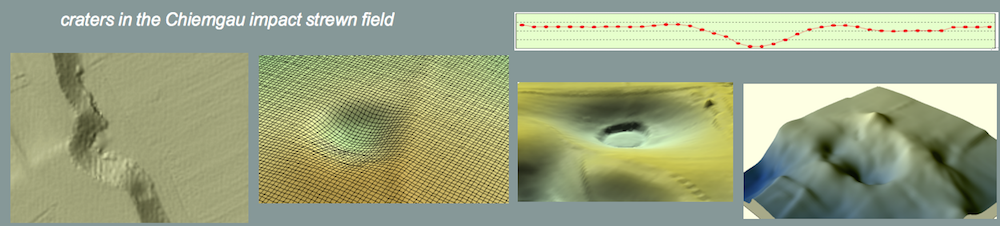
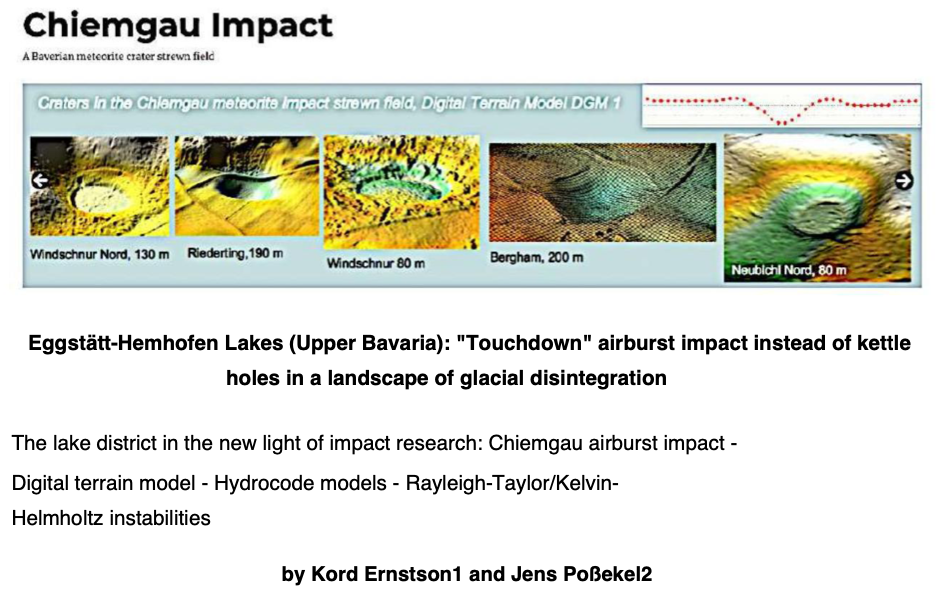
The Chiemgau impact and the Digital Terrain Model DGM 1
Article Part 3: the larger-sized craters
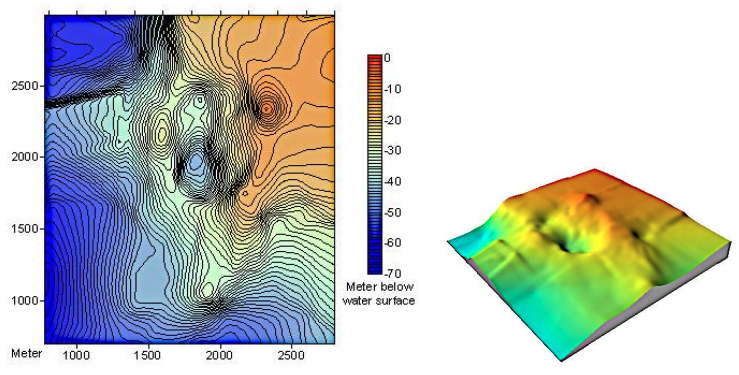
Continuing our description with a summary of the impact inventory of the Chiemgau strewn field (Part 2, Part 1) we present here the third part, which is again published on the science portals Researchgate and Academia as as preprint. The article can be downloaded here as a PDF file (click on the title):
The Chiemgau Impact (Germany) meteorite crater strewn field and the role of Digital Terrain Models. – Model craters, Part 3: the large craters – Lake Brunnensee/Griessee crater, Lake Obing crater, the Tittmoning (Asten, Leitgering) craters, Lake Chiemsee multiple crater, Eglsee crater, Lake Eschenau and Lake Laubensee craters, Lake Bärnsee crater, Lake Tüttensee crater ensemble. – K. Ernstson and J. Poßekel
The Chiemgau impact and the Digital Terrain Model DGM 1
Article Part 2: the medium-sized c
Article Part 2: the medium-sized craters
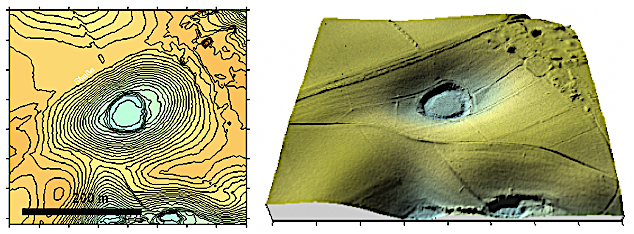
Continuing our description with a summary of the impact inventory of the Chiemgau strewn field (Part 1), we present here the second part, which is again published on the science portal Researchgate as a preprint. The article can be downloaded here as a PDF file (click on the title):
The start image above shows a topographic map and terrain surface of the digital terrain model DGM 1 for the natural monument at the Seeon horse farm, which has always been listed in maps and descriptions as a typical dead ice hole from the last ice age and is listed by the Bavarian State Office for the Environment (LfU) as a geotope particularly worth seeing.
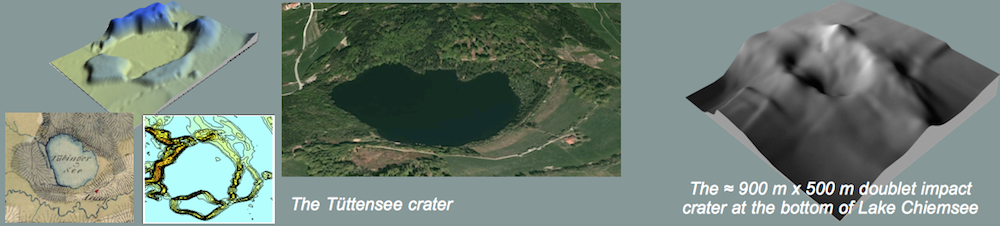
The DGM 1 symbolizes a necessary rethinking of the LfU’s Bavarian ice age research, which continues to adhere to a dead ice hypothesis that has never been scientifically or geologically substantiated, with countless so-called dead ice holes and their designation as geotopes, which was recently documented in an article and can be seen as an example of scientific falsification by the LfU in the case of the Tüttensee meteorite crater.
2 contributions to the AGU Conference 2025
The following two iPosters have been accepted for presentation at the renowned American Geophysical Union conference in New Orleans in December. The abstract announcements can now be downloaded:
AGU website:
Each year, AGU’s annual meeting, the largest gathering of Earth and space scientists, convenes 25,000+ attendees from 100+ countries to share research and connect with friends and colleagues. Scientists, educators, policymakers, journalists and communicators attend AGU25 to better understand our planet and environment, opening pathways to discovery, opening greater awareness to address climate change, opening greater collaborations to lead to solutions and opening the fields and professions of science to a whole new age of justice equity, diversity, inclusion and belonging.
Ice Age, dead ice, meteorite impact, and the digital terrain model
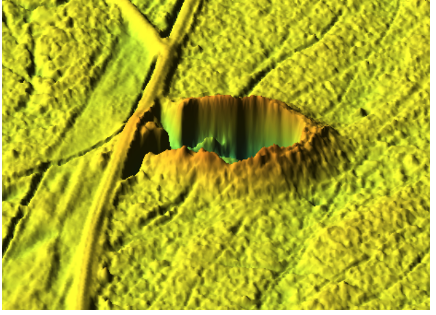
The complete article can be downloaded here as a PDF file:
***********************************
The Schlitzer Kauten (Hesse) and the high-resolution Digital Terrain Model DGM 1: an airburst impact event with a crater strewn field
Kord Ernstson, Jens Poßekel and Rudolf Auth
Please note that this article is a computer translation of the original German text and may contain incorrect wording.
New Poster: meteorite impact and the Digital Terrain Model
Lunar & Planetary Science Conference LPSC 2025
MetSoc Meeting 2025
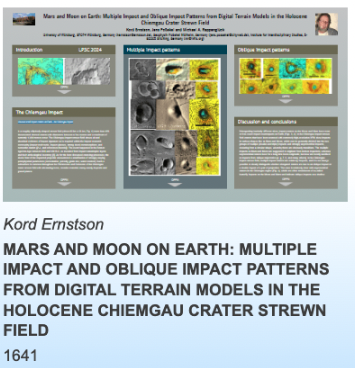
Lunar & Planetary Science Conference LPSC 2024
https://lpsc2024.ipostersessions.com/?s=40-83-1A-8D-B8-91-6E-54-A4-F3-B3-36-13-85-48-1F
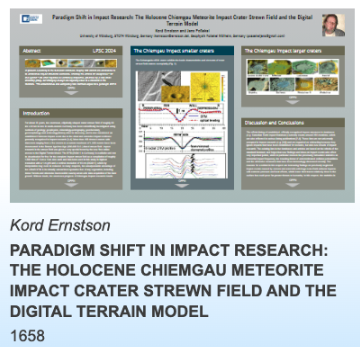
https://lpsc2024.ipostersessions.com/?s=D7-F9-72-1A-EB-74-15-15-BC-2B-1B-DC-54-85-E6-C9
AGU Meeting 2024
